Key Highlights
Tailored Heavy-Duty and Standard series cover C5-M coastal environments and large-scale rural/highway deployments, respectively, enabling precise risk-budget matching for your projects.
Both series inherit unified production standards, including Sa 2½ surface preparation, weld inspection, and precision flange machining. This delivers stable industrial-grade quality without over-engineering costs.
Factory-laser-cut mounting brackets and CNC flanges eliminate on-site drilling and shimming. This protects the anti-corrosion coating and enables fast, flawless integration with third-party devices.
Slip-joint and modular structures maximize 40HQ container utilization, effectively reducing per-unit landed costs and improving bidding profitability for bulk orders.
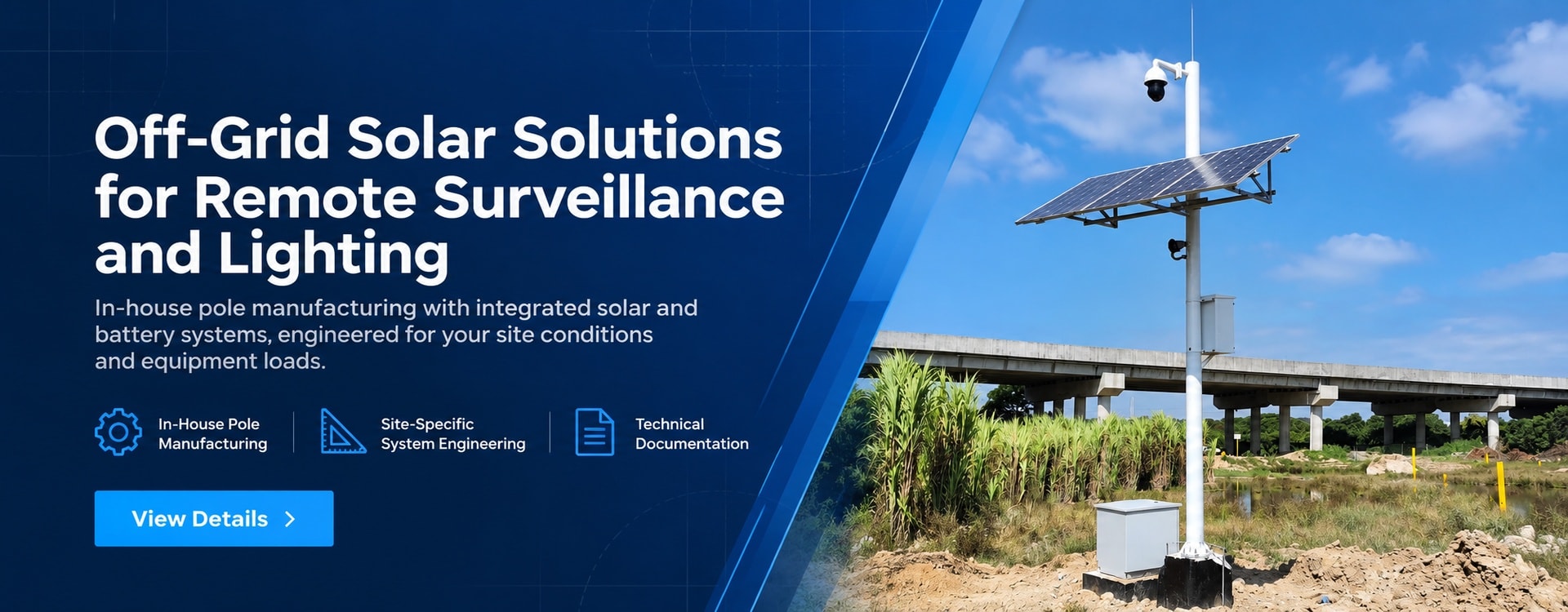
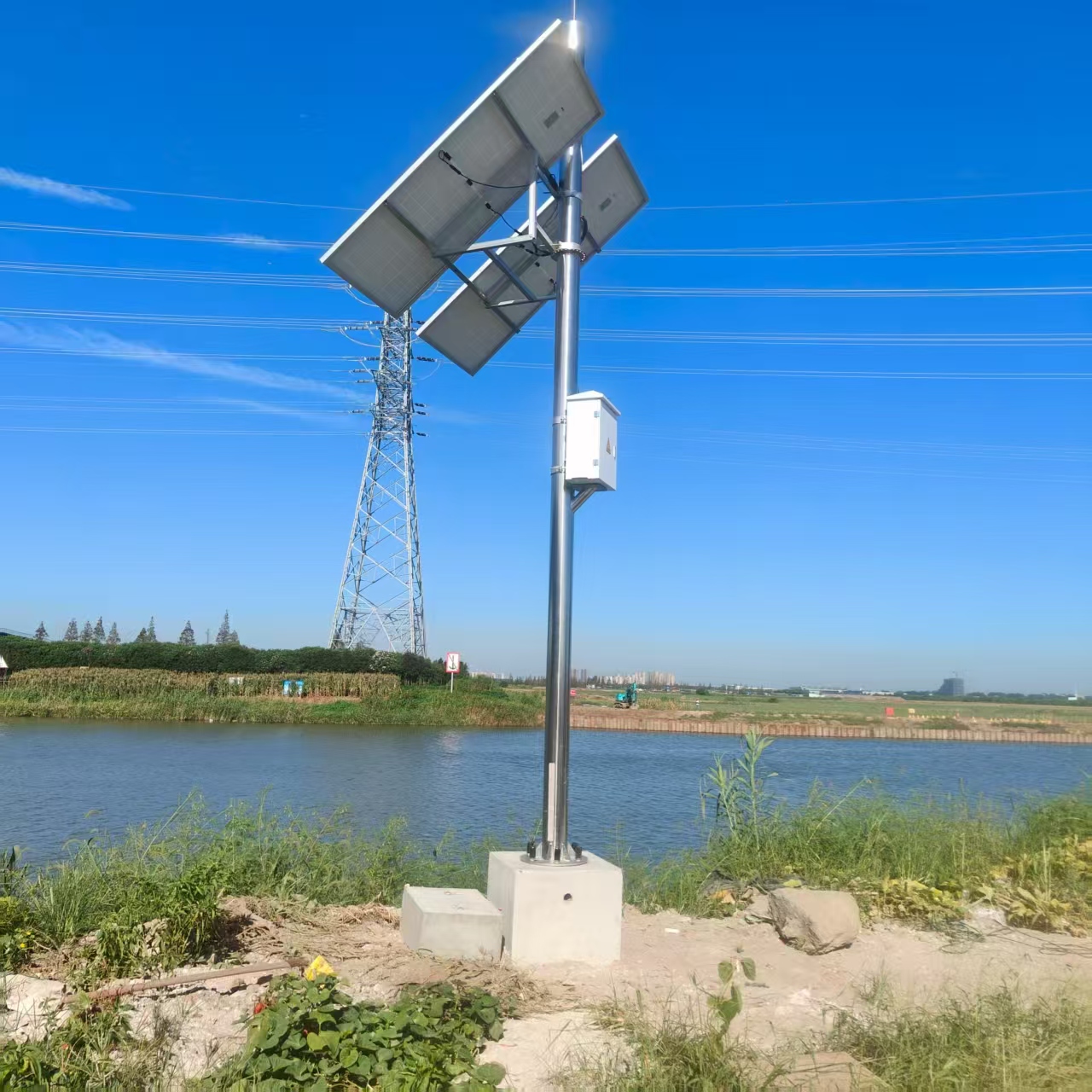
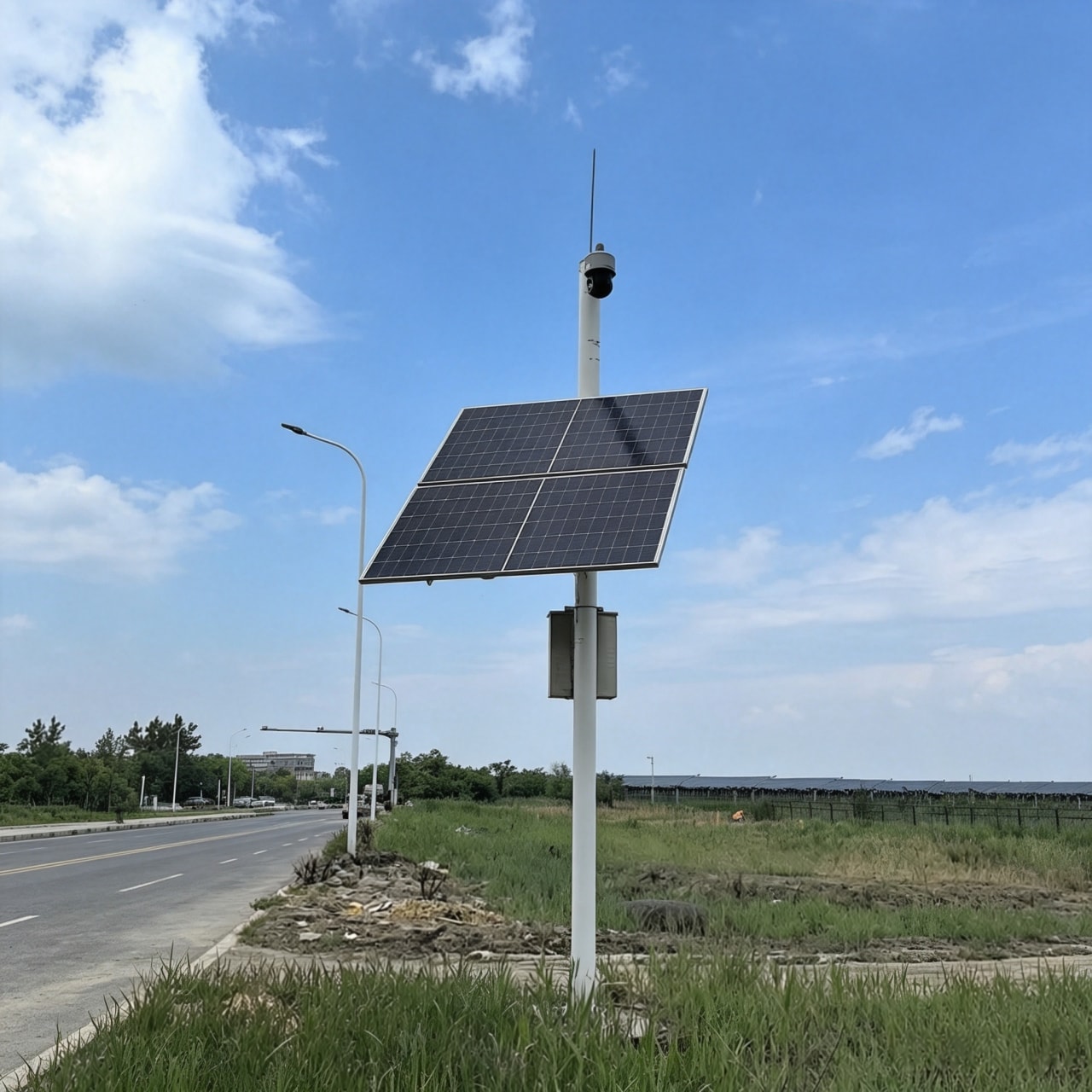
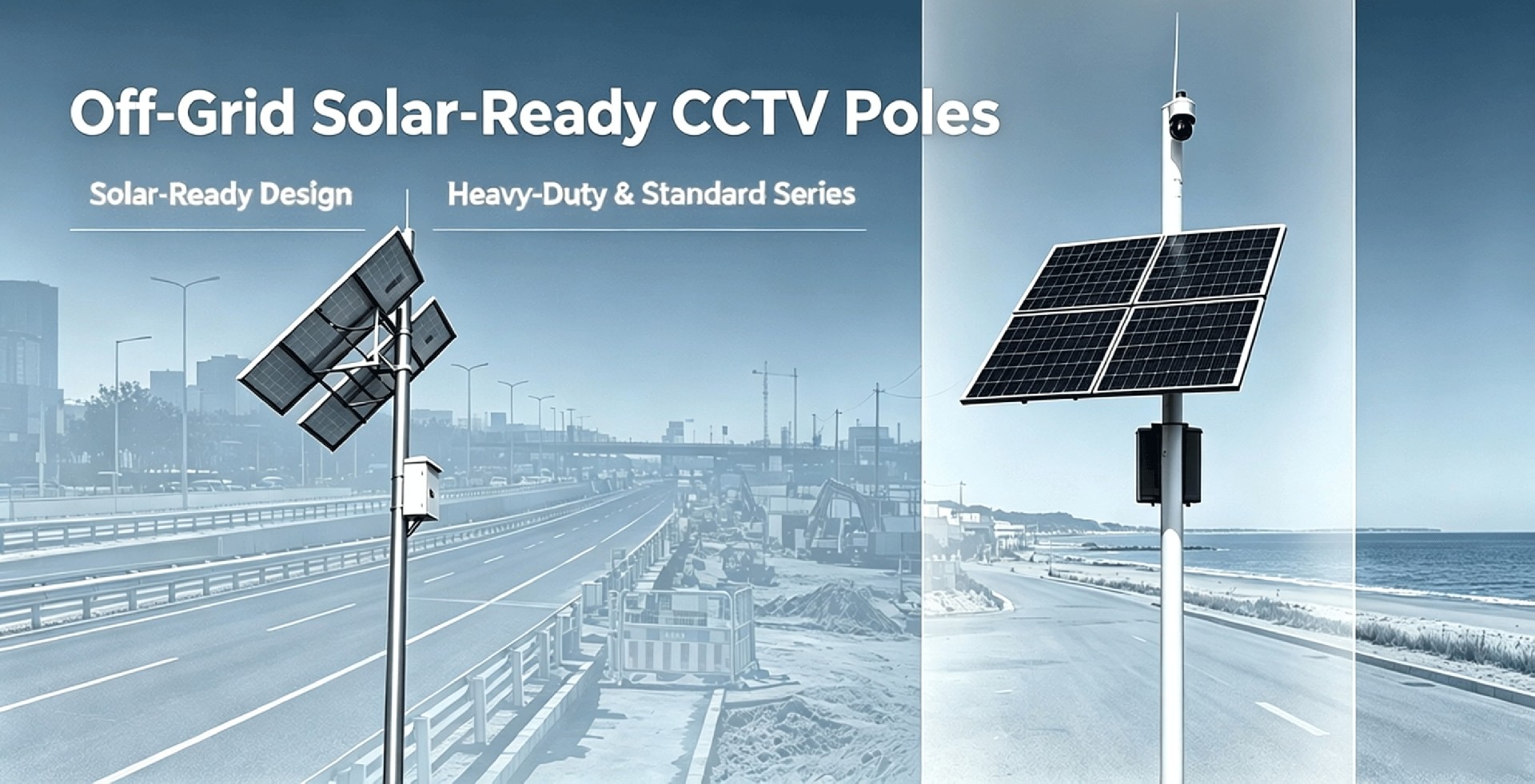
Engineered for projects deployed in off‑grid locations, our Off‑Grid Solar Surveillance Poles combine robust structural performance with a pre‑engineered solar mounting interface. The product range includes two series: Heavy‑Duty, built for radar, 5G small‑cell, and meteorological equipment loads; and Standard, designed for PV arrays paired with one or two surveillance cameras. Offered in carbon steel and stainless‑steel material options, these poles suit applications ranging from rural roadway monitoring to coastal petrochemical facility sites.
Engineering Note: The pole itself supplies the solar mounting interface, internal cable conduit, and reserved structural load capacity. MPPT charge controllers, lithium‑ion battery banks, and inverters shall be procured separately for each project. This approach delivers maximum configuration flexibility to match unique site‑specific requirements.
| Parameter | Specification |
| Height | 4 – 20 m, customizable |
| Rated Total Payload | ≤50 kg (Standard) /200 kg+ (Heavy‑Duty), includes camera, sensor, solar‑hardware weight |
| Material | Q235B / Q355B carbon steel |
| Wall Thickness | 3mm – 16mm (Customized per height & load) |
Surface Finish | Hot-dip galvanized + powder coating (CS) / brushed + passivated (SS) |
| Corrosion Rating | C3‑C5‑M configurable by selected material & surface‑finish option |
| Series | Material | Applicable Wind Speed | Rated Total Payload | Best For |
| Heavy-Duty | Q355B CS | Up to 49 m/s (3‑sec gust, approx.177 km/h)‑ project‑dependent | 200kg+ | Radar, 5G small cells, multi-load heavy sites |
| Heavy-Duty | SS316L | Up to 49 m/s (3‑sec gust, approx.177 km/h)‑ project‑dependent | 200kg+ | Coastal, petrochemical, high-salinity atmosphere |
| Standard | Q235B CS | Up to 35 m/s (3‑sec gust, approx.126 km/h)‑ project‑dependent | ≤ 50kg | Rural roads, budget-sensitive projects |
| Standard | SS304 | Up to 35 m/s (3‑sec gust, approx.126 km/h)‑ project‑dependent | ≤ 50kg | Coastal light-duty monitoring |
Supported by an ISO 9001:2015 quality management system, we can adapt pole design, manufacturing quality control, corrosion protection, and technical documentation to project-specific standards and local requirements, supporting overseas project approval, procurement, and acceptance.
Structural Design & Wind Load Verification: Structural calculations can be performed in accordance with EN 40 / EN 1993, AASHTO, applicable AS/NZS standards, SASO requirements, or other project-specified codes. Design verification can incorporate site wind speed, equipment loads, mounting height, and environmental conditions.
Welding & Manufacturing Control: Welding procedures and quality control can be adapted to applicable EN 1090 execution requirements and ISO 3834 welding quality requirements, with corresponding process, inspection, and documentation controls implemented as required by the project.
Corrosion Protection: Hot-dip galvanizing and coating systems can be configured according to the project environment and required service life. Treatments can be specified to ISO 1461, ASTM A123/A123M, or other project requirements for standard outdoor, coastal, high-humidity, and high-salinity environments.
Engineering Documentation Support: Project documentation can include structural calculation reports, shop drawings, material certificates, welding records, galvanizing or coating inspection reports, dimensional inspection records, and factory quality documentation for client, consultant, or EPC review.
Multi-Market Project Support: We support project requirements across Europe, North America, the Middle East, and Asia-Pacific. Applicable design standards, inspection requirements, and document packages can be defined according to the project location and technical specification.
Many project specifiers often face a dilemma with single‑line manufacturers: overspending on over‑engineered poles or risking safety with under‑spec alternatives. We solve this by independently developing our Heavy‑Duty and Standard series based on precise wind load and structural data. This targeted engineering allows you to match project budgets to exact risk profiles, eliminating both wasted capital and safety compromises.
Many manufacturers relegate standard poles to lower‑tier production lines, resulting in inconsistent quality and premature failure. We eliminate this vulnerability by applying our rigorous manufacturing protocols—such as Sa 2½ surface preparation and strict UT testing—across our entire product line. While our Heavy‑Duty and Standard series are engineered for different load capacities, every pole shares the same industrial‑grade quality baseline, ensuring zero compromise on build quality regardless of the series you choose.
Field modifications like drilling and shimming routinely compromise factory‑applied anti‑corrosion coatings, leading to premature rust and failed inspections. Our poles feature pre‑engineered, laser‑cut interfaces that guarantee plug‑and‑play compatibility with major PV and camera brands.
Traditional pole shipping is plagued by high freight costs due to excessive volume, which erodes project margins. Our modular slip‑joint and flange designs are engineered specifically to maximize 40HQ container utilization. Whether deploying standard rural poles or heavy‑duty coastal structures, projects gain predictable, significantly reduced per‑unit landed costs, strengthening overall project profitability.
Pre-drilled mounting interfaces and universal brackets ensure seamless integration with mainstream global brands:
Cameras: Bullet, PTZ, Dome (Standard Interface), Laser PTZ.
Sensors: Environmental, Traffic & Methane Gas Detection.
Enclosures: Universal Security Power Supplies & Battery Enclosures.
🔧 Precision Fit: Custom hole drilling, crossarms, and flange patterns are available upon request based on CAD templates. Precision laser-cut top brackets can be tailored to specific camera footprints (e.g., Axis, Hanwha, Bosch), eliminating on-site drilling and accelerating installation.
The pole is pre-engineered for third-party off-grid solar power systems.
| Structural & Mechanical Interfaces (Included) | Electrical & PV Components (By Others) |
Pre-welded solar mounting points | Solar panels & racking |
| Internal Cable conduit & entry points | MPPT charge controller |
| Structural load allowance (Wind/Payload) | Lithium battery bank |
| Waterproof equipment mounting box | Inverter & Surveillance Camera |
⚠️ Important Selection Notice:
Heavy‑Duty specification poles shall be adopted for projects at highways, road intersections, coastal high‑wind zones, or applications fitted with heavy payloads such as PTZ cameras and radar equipment.
Standard‑specification poles are sufficient for general‑duty deployments. These include rural locations, ordinary campuses, and non‑critical sites equipped only with light‑weight single‑ or dual‑camera loads, where wind conditions are moderate. For these moderate‑condition projects, Heavy‑Duty poles are not mandatory, and Standard‑specification poles will meet project requirements.
Standard‑specification poles are not suitable for the harsh high‑wind and heavy‑payload operating conditions mentioned above. Mis‑specification may lead to project acceptance failure, potential pole‑overturning risk, and high long‑term maintenance costs.
Rural Highway Surveillance: 6 m Standard Poles, 180 Units deployed for state‑road off‑grid monitoring in areas without mains‑power access.
Petrochemical Pipeline Monitoring: 8 m Heavy‑Duty SS316L Poles, 45 Units, Coastal Plant perimeter security.
Remote Site Security: 4 m Standard Poles + Solar Kits, 120 Units, Off-Grid Compound.
⚡ Galvanic Corrosion Prevention: Install non-conductive isolating gaskets at every dissimilar-metal joint, especially in coastal salt-spray locations.
💧 Drainage & Sealing: Keep base drainage openings unobstructed; hand-hole covers and seals must remain intact. Never bury flange plates underground.
🛡️ Surface & Coating Integrity: Protect hot-dip galvanized + powder-coated (CS) or brushed/passivated (SS) surfaces from mechanical impact damage during handling and erection. Apply compatible touch-up coatings promptly to any scratched or chipped areas.
🔌 Grounding Requirement: Complete proper grounding and equipotential bonding in compliance with local electrical codes.
🏗️ Foundation Rules: Anchor bolts and concrete foundations must satisfy local wind-load requirements. Erect poles only after concrete has fully cured.
Project‑specific wind‑load reports, 2D‑CAD drawings, installation guides, and tender documents are available upon request.
General‑purpose technical documents are available via our [Download Center]→
🚀 Rapid Delivery: Standard heights typically ship within 3–5 weeks.
💰 Volume Pricing: Tiered pricing structures available for bulk orders.
📦 Export-Grade Packaging: Moisture-proof and shock-resistant packaging optimized for safe container loading.
📊 Real-Time Tracking: Dedicated project managers providing regular production progress updates.
Q1: Do your solar‑ready surveillance poles include solar panels, batteries, charge controllers, or surveillance cameras?
A: No. We supply pole‑only structural hardware. Solar panels, battery enclosures, controllers, and cameras need to be sourced separately by the buyer. Our poles are factory pre‑drilled with mounting interfaces to fit third‑party solar and surveillance hardware.
Q2: What material options are available for your solar‑ready off‑grid poles?
A: We offer carbon‑steel and stainless‑steel variants.
‑ Carbon‑steel: Q235B (standard grade) / Q355B (heavy‑duty grade), hot‑dip galvanized plus powder‑coated.
‑ Stainless‑steel: SS304 (standard grade for C3‑C4) / SS316L (heavy‑duty for C4‑C5‑M marine environments).
Each material comes in standard‑duty and heavy‑duty configurations for different wind‑speed and payload requirements.
Q3: Why do you distinguish standard‑duty and heavy‑duty versions for solar‑ready poles? What is the key difference?
A: Solar panels add extra weight and a large wind sail‑area, which increases the wind‑induced bending moment on the pole.
‑ Standard‑duty: for ≤35 m/s wind speed, total combined payload ≤50 kg, suited for inland / mild‑coastal C3‑C4 sites with small‑size single solar‑panel setups.
‑ Heavy‑duty: for ≤49 m/s wind speed, total combined payload ≥100 kg, suited for coastal / typhoon‑prone sites, multi‑panel solar arrays and heavy multi‑sensor equipment.
Q4: How do you define “total rated payload” for solar‑ready poles?
A: Total rated payload includes the full combined weight: cameras, sensors, solar panels, solar mounting brackets, battery enclosures, and all associated installation hardware. Pole deflection performance is evaluated based on this full combined payload.
Q5: Are your wind‑load calculations considering solar‑panel wind sail‑area?
A: Yes. Our project‑specific wind‑load reports explicitly include additional wind sail‑area generated by solar‑panel assemblies. We do not reuse ordinary camera‑pole calculations which ignore solar wind exposure. Please provide solar‑panel dimensions for accurate engineering assessment.
Q6: Which corrosion class do carbon‑steel and stainless‑steel poles support respectively?
A:
‑ Hot‑dip galvanized carbon‑steel: C3‑C4 for standard‑duty; C4‑C5‑M for heavy‑duty grade.
‑ SS304 stainless‑steel: suitable for C3‑C4 inland and mild‑coastal locations, not recommended for continuous heavy salt‑spray C5‑M marine sites.
‑ SS316L stainless‑steel: molybdenum‑alloyed for C4‑C5‑M heavy‑marine coastal and port deployments.
Q7: What documents can you provide for tender submission and project approval?
A: We can provide: product specification sheets, 2D CAD / DWG drawings, installation guides, wind‑load calculation reports complying with ASCE 7‑16 / EN 1991, EN 10204‑3.1 Mill‑Test‑Certificates (MTC), welding inspection records, and CE / RoHS declarations upon request.
Q8: What is galvanic corrosion and what precautions do I need when installing solar‑panel brackets?
A: Galvanic corrosion occurs when dissimilar metals make direct electrical contact under humid or salt‑spray conditions. When fitting stainless‑steel solar brackets onto galvanized carbon‑steel poles or different‑grade stainless‑steel hardware, UV‑resistant non‑conductive isolating gaskets/washers must be installed at every metal‑to‑metal joint to prevent corrosion. This is a mandatory site‑installation requirement for coastal and high‑humidity projects.
Q9: Can you customise pole height, wall thickness, flange pattern, handhole position and solar‑bracket mounting hole layout?
A: Yes. Custom dimensions, flange bolt patterns, hand‑access hatch positions, and pre‑drilled solar‑mount hole layouts are available. Please share your CAD drawings or detailed technical requirements for quotation and engineering review.
Q10: What is your warranty coverage for solar‑ready surveillance poles?
A: Our structural warranty covers failure of pole tube and weld‑joints under project‑specified wind‑speed and total‑payload operating conditions.
Warranty does NOT cover: mechanical impact damage during transport/erection, improper field installation, operation beyond published design limits, and natural ageing or wear of surface finishes (galvanizing, powder‑coating, stainless‑steel passivation discoloration).
Q11: What are your typical production lead‑times for bulk export orders?
A: For standard‑spec solar‑ready poles: 3‑4 weeks. For heavy‑duty or heavily custom‑configured units: 4‑5 weeks. Lead time is subject to order quantity and raw‑material availability.
Specifications (material grade, payload capacity, corrosion resistance) are provided for reference under standard conditions. Actual performance varies based on local environmental factors and installation practices. We strongly recommend consulting a local structural engineer to confirm compliance before finalizing your project specifications.
[ Request Engineering Review ] — Get a Project-Specific Wind-Load Evaluation & Quotation.
Compare Heavy-Duty vs. Standard to find the best value for your site.