Project Overview
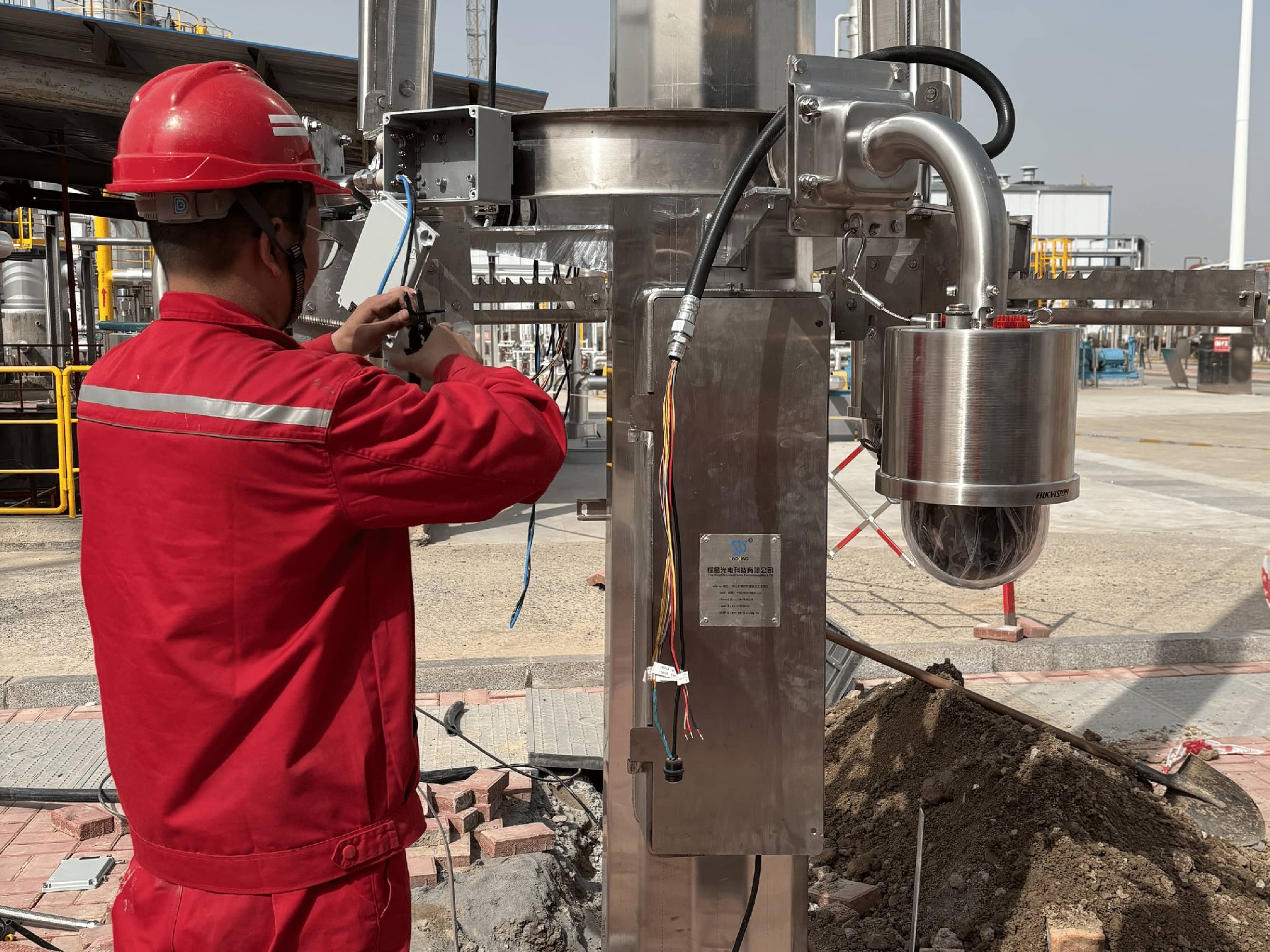
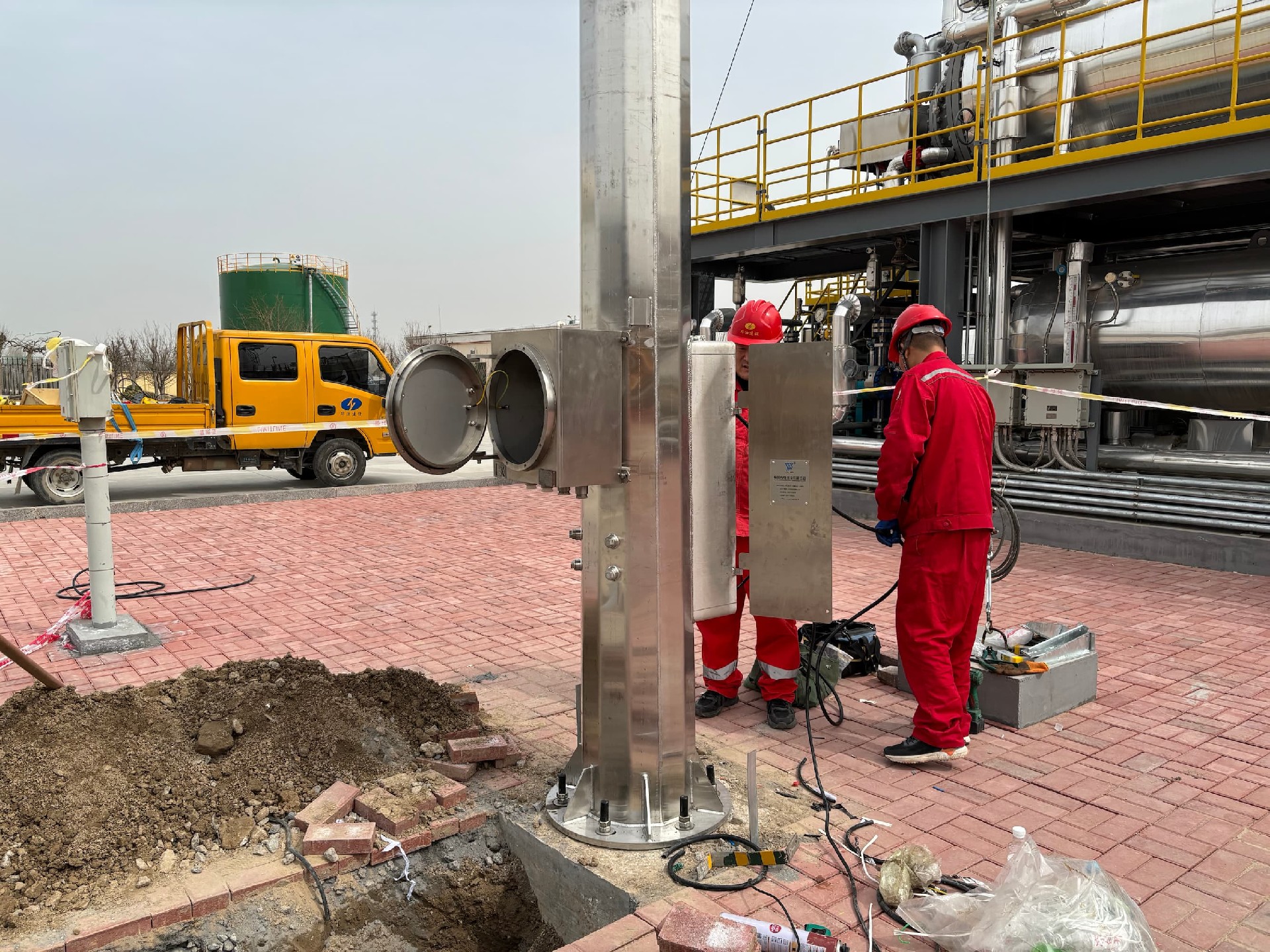
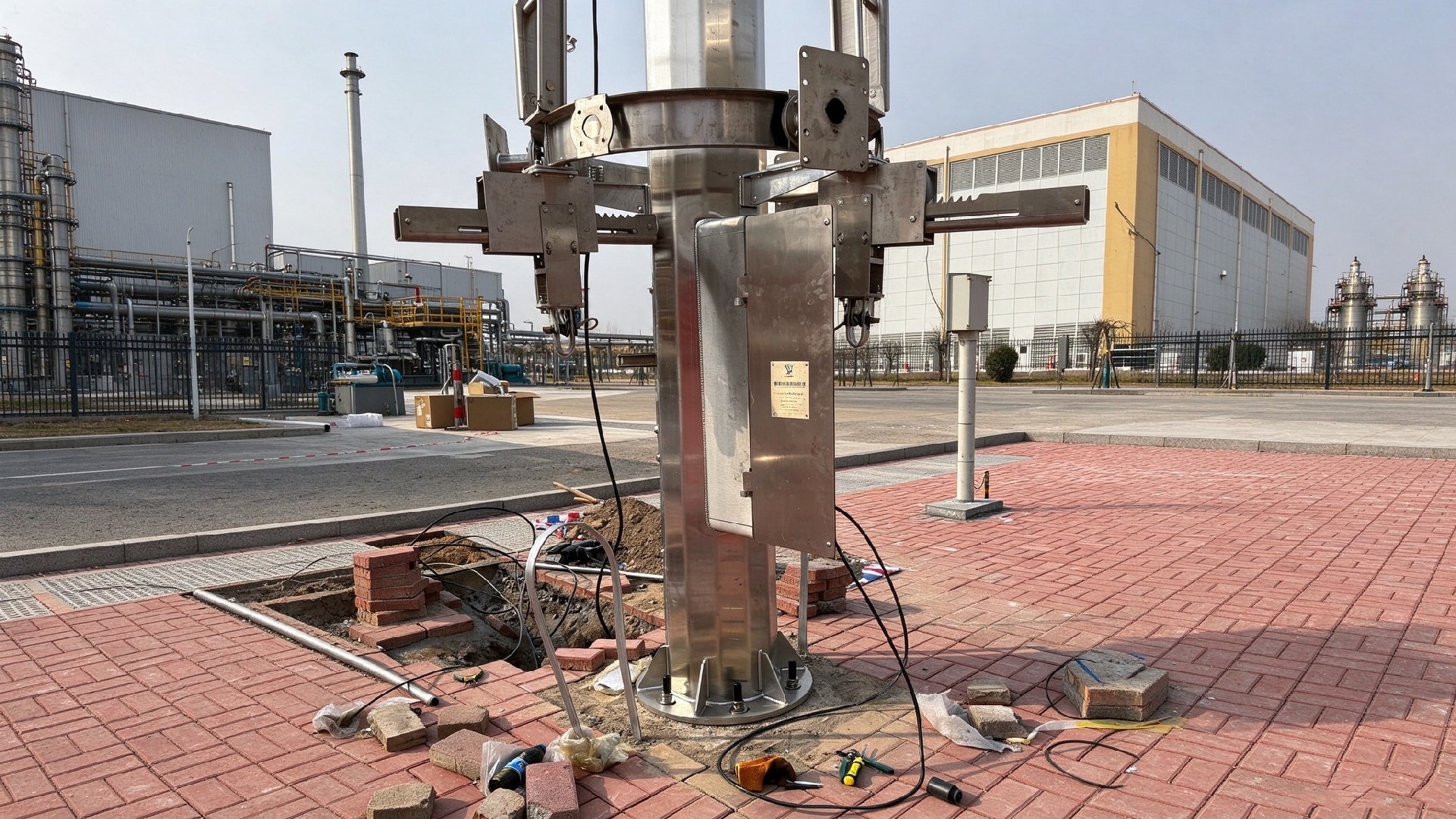
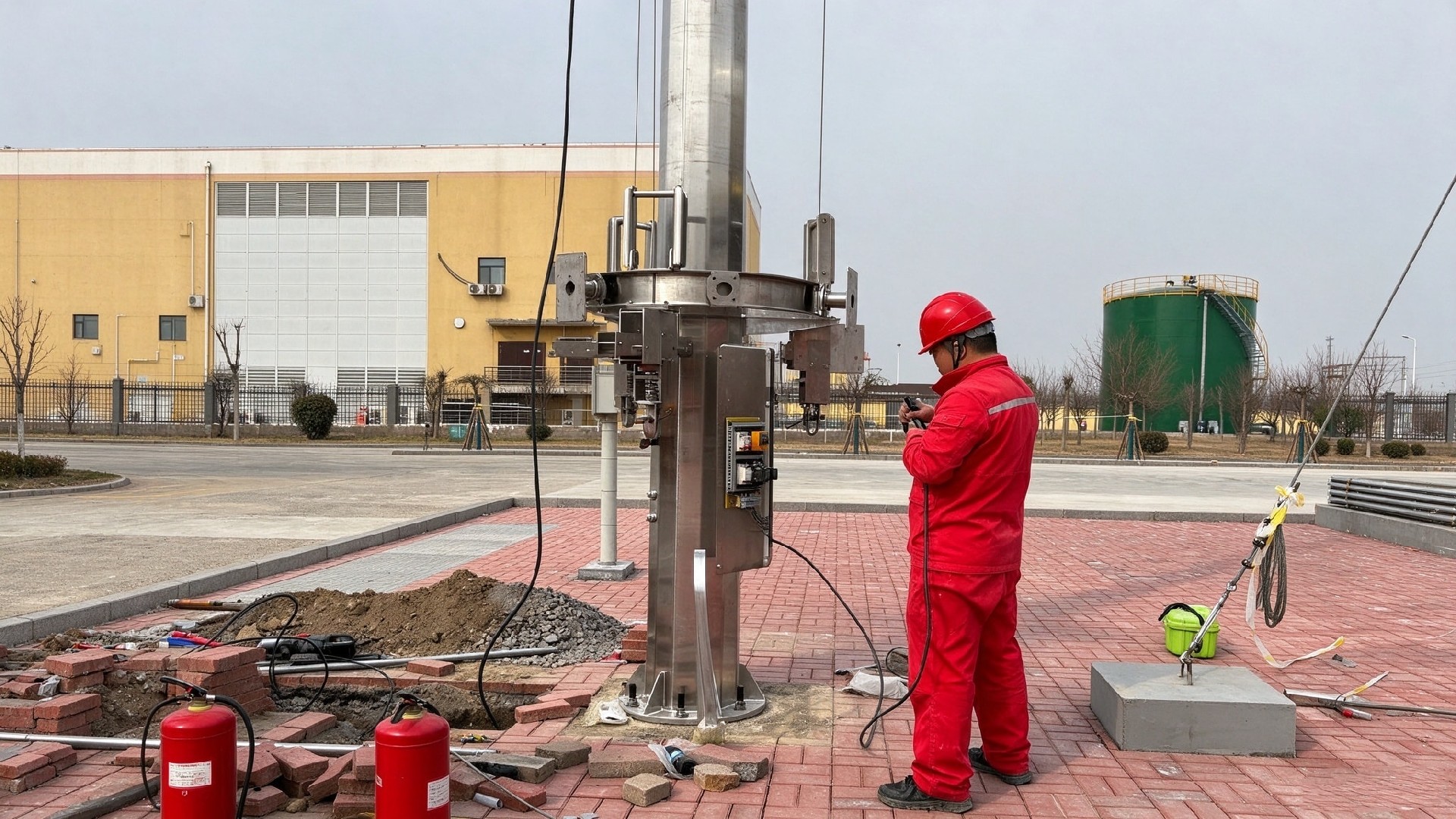
On March 10, 2025, our company installed six sets of 304 stainless steel, 12-meter-high telescoping security camera poles for the Wen 23 Gas Storage Facility Injection-Production Station of Henan Puyang Gas Storage Company, under China Oil & Gas Pipeline Network Corporation (PipeChina).
| Project Type | Security Monitoring System (Lowerable Camera Poles) for Gas Injection & Extraction Station |
| Deployment Scope | 6 units of 12-meter SS 304 stainless steel lowerable CCTV poles |
| Application Scenario | National Energy Infrastructure / Underground Gas Storage Zone, Hazardous Area (Ex-Zone) |
| Delivery Schedule | Installation completed on March 10, 2025 (75-day lead time from order placement to site completion) |
| Design Standards & Compliance | Engineered in accordance with Chinese structural codes; structural calculations verifiable against Eurocode 3 (EN 1993-1-1) and EN 40-3-3:2013. Material supplied with EN 10204 3.1 compliance certificates for SS 304 stainless steel. Hazardous area design compliant with IEC 60079-10-1 / IEC 60079-14, adaptable to regional international standards (ATEX, NFPA, NEC, etc.). Full documentation package including structural calculation reports and material traceability certificates. |
■ 100% First-Pass Acceptance: All 6 lowerable CCTV poles passed structural testing and system integrator inspection on the first attempt, fully meeting the end-user's technical specifications. Zero rework or site modifications eliminated project delays, rectifications, and variation costs.
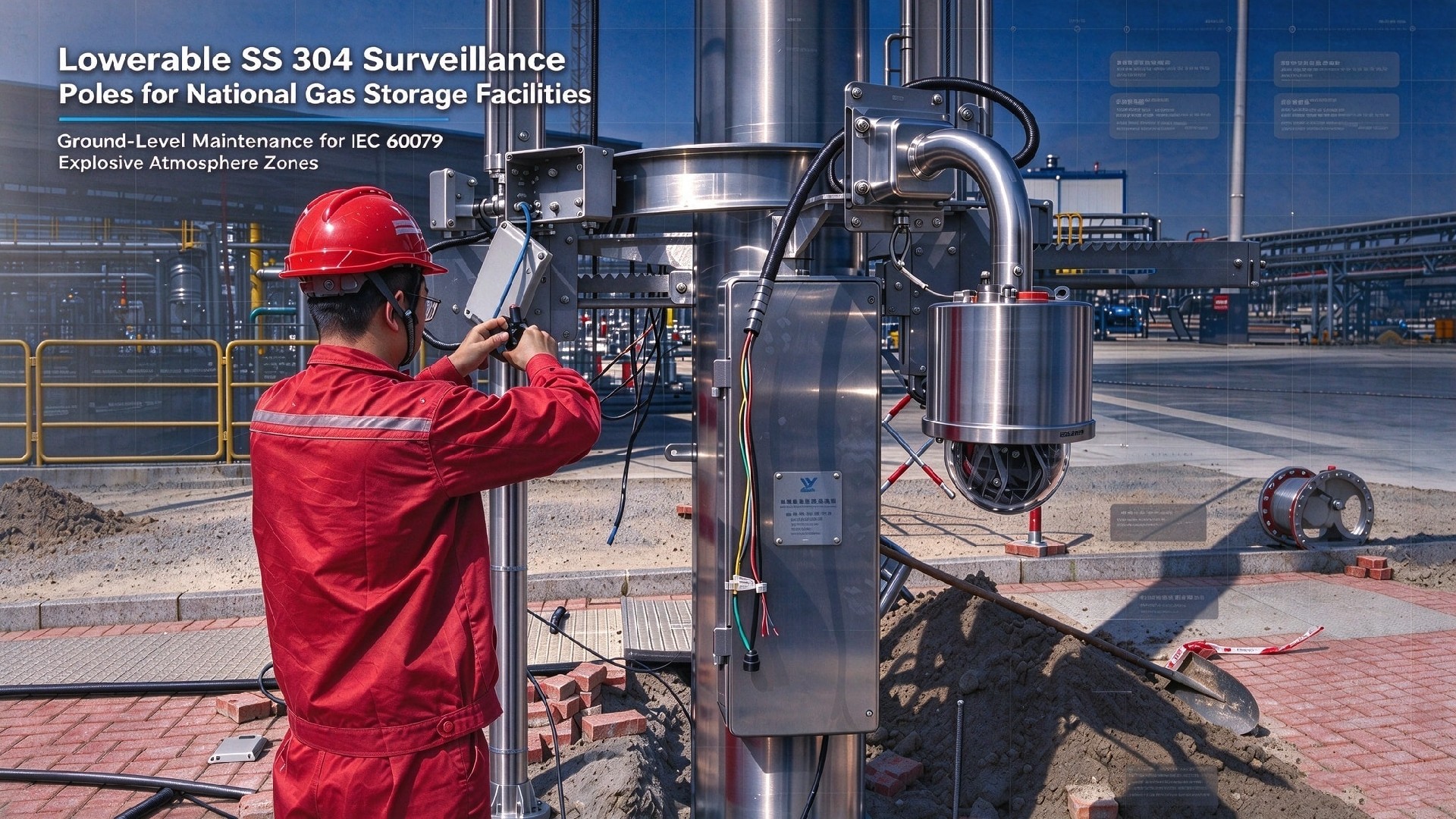
■ Zero Work at Height (WAH) Exposure: The proprietary internal lowering mechanism allows cameras to be installed and serviced entirely at ground level, eliminating fall risks in hazardous zones and removing the need for WAH permits, significantly reducing PTW (Permit to Work) administrative workload.
■ Elimination of Hot Work Permits in Ex-Zones: Poles are fully pre-fabricated in the factory with bolt-together site assembly, requiring zero welding or grinding on site. This eliminates hot work permit applications in explosion-hazard areas, cutting down labor allocation for safety reviews, gas monitoring, and site supervision.
■ Compressed Site Installation Window: All equipment is pre-assembled at ground level without requiring heavy-duty cranes on site. This shortens the operational shutdown window and minimizes disruption to active oil and gas production facilities.
■ 25+ Year Corrosion-Resistant Design Life: Fabricated from SUS 304 stainless steel with a natural passivation film providing inherent corrosion resistance. Backed by ASTM B117 salt spray testing (≥1,000 hours with no red rust), eliminating the need for hot-dip galvanizing and lowering long-term maintenance and replacement costs.
"This lowerable monitoring system allows both camera installation and routine maintenance to be performed entirely at ground level, eliminating the need for cranes and scaffolding. Because the poles are pre-fabricated off-site with zero hot work required, we completely bypassed the hazardous area hot work approval process. Based on these proven benefits, we will definitely continue using this solution for our Phase II expansion."
— Project Management Team, Wen 23 Gas Injection & Extraction Station
Client: Henan Puyang Wen 23 Gas Injection & Extraction Station (Strategic underground gas storage facility operated by PipeChina, formerly under Sinopec).
As one of China's largest underground gas storage facilities, the Wen 23 facility is a vital node in the national energy supply chain, providing critical peak-shaving and natural gas reserves for the Beijing-Tianjin-Hebei region during winter heating peaks.
Operating as a high-pressure natural gas injection and extraction facility under stringent HSE management standards, large portions of the site are classified as explosive gas atmospheres (Zone 2, per IEC 60079-10-1:2020 / GB 50058-2014).
This complex operating environment presented five major engineering challenges:
1. Ex-Compliance: All equipment within hazardous zones must eliminate spark and static electricity risks. Traditional carbon steel poles requiring on-site welding or drilling were unacceptable.
2. No Work at Height (WAH): Cranes and mobile elevated work platforms (MEWPs) are strictly prohibited during active production phases; 12-meter camera maintenance had to be executed entirely at ground level.
3. Corrosive Environment: Long-term exposure to hydrogen sulfide (H2S) containing natural gas demanded material-grade corrosion resistance exceeding standard hot-dip galvanizing.
4. Mechanical Reliability: The lowering mechanism must operate reliably over years of outdoor, multi-cycle usage without jamming or mechanical failure.
5. Structural Rigidity: PTZ dome cameras require extremely low pole deflection under wind loads to guarantee stable video feeds and preset positioning accuracy.
|
|
1. Hazardous Area Compliance (Ex-Proof)
→Challenge: Elimination of spark and static risks in explosive atmospheres; no on-site hot work permitted.
→Solution: Internal cable routing with sealed entry/exit points; equipped with explosion-proof junction boxes installed at an accessible working height. Dedicated grounding terminals ensure grounding resistance < 4 Ω, eliminating static accumulation risks. All penetrations and holes are pre-fabricated in the factory, requiring zero on-site drilling or hot work.
2. Ground-Level Maintenance (No High-Altitude Work)
→Challenge: Strict bans on cranes and aerial work platforms during operational phases.
→Solution: Equipped with a lifting mechanism, single-operator installation and maintenance of all cameras can be easily completed. Dual mechanical safety locks are installed at both the raised and lowered positions.
3. H2S Corrosive Process Environment
→Challenge: Standard carbon steel with hot-dip galvanizing suffers from inadequate lifespan under sulfur-bearing gas exposure, accelerating corrosion once coatings breach.
→Solution: Fabricated from SS 304 stainless steel, relying on its self-healing passive oxide film rather than applied coatings for corrosion resistance. Salt spray resistance≥1,000hours (ASTM B117), with a designed service life of 25+ years (ISO 12944 C3–C4).
4. Mechanical Reliability of Lowering Mechanism
→Challenge: In outdoor temperature-fluctuating and dusty environments, lifting mechanisms are prone to jamming during repetitive operation, adversely affecting long-term maintenance and reliability.
→Solution: Lifting mechanisms undergo rigorous cycle durability testing. Sliding interfaces utilize wear-resistant, anti-corrosive engineering structures adapted to harsh outdoor conditions, ensuring smooth long-term operation. Mechanical locking features a redundant design for secure and stable multi-cycle lowering and raising.
5. Deflection Control for PTZ Cameras
→Challenge: High-resolution PTZ cameras suffer from image jitter and preset position drift even with minimal pole sway under wind loads.
→Solution: 12 m tapered dodecagonal pole with reinforcing ribs at the camera mounting interface. Verified via Finite Element Analysis (FEA) under 50-year return period basic wind pressure, controlling top pole deflection to ≤H/200 (< 60 mm), fully satisfying PTZ operational stability requirements. Designed in accordance with GB 50017 and GB 50135, with verification capabilities against EN 40 / AS/NZS 1170.2 per project requirements.
|
|
Scalable Delivery Capabilities
- Annual production capacity of 50,000 tons, capable of handling large-scale security and lighting pole projects
- Stable raw material supply chain supporting mixed scheduling of multiple materials and pole types, with phased delivery aligned with project schedules
- Full-batch quality inspection and document traceability, providing material certificates and anti-corrosion test reports per batch
- 100% on-time delivery and 100% acceptance rate on historical projects
- 83.2% repeat purchase rate for security and lighting poles (2020–2025)
- Grade II Professional Contractor Qualification for Electronic and Intelligent Engineering
Key Client Endorsements
- Supplier for China National Petroleum Corporation (CNPC) since 2020
- Supplier for China Petrochemical Corporation (Sinopec) since 2020
- Supplier for PipeChina since 2020
- Supplier of apron navigation lighting poles for Beijing Capital International Airport
- Supplier of fuel depot lighting poles for Beijing Daxing International Airport
1. Engineering & Design Confirmation: Wind load calculations and FEA structural analysis completed within 48 hours of order confirmation, yielding foundation construction drawings matched to camera payload and site clearance conditions.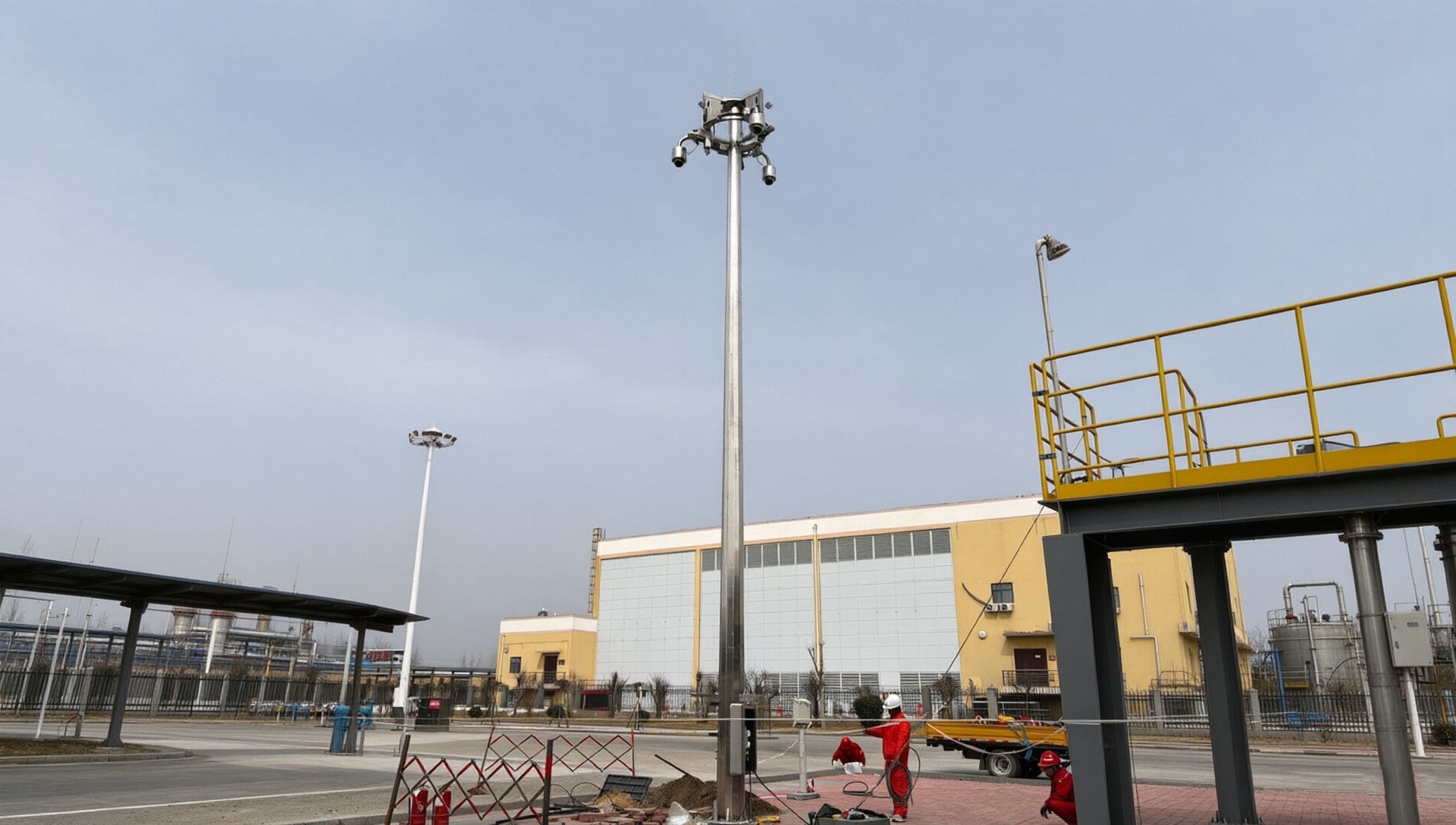
2. Manufacturing & Quality Control: SS 304 stainless steel coils supplied with original Mill Test Certificates (MTC). Quality control hold points established across CNC bending, TIG welding, 500-cycle lowering mechanism testing, and final load testing.
3. Packaging & Logistics: Individual anti-scratch protective film wrapping on poles, secured in custom steel transport frames with locking restraints to prevent transit damage. Transported from our manufacturing plant in Bazhou, Hebei, to the project site in Puyang, Henan, via dedicated heavy-haul transport, covering approximately 450 km.
4. Installation, Commissioning & Acceptance: Supervised on-site by a specialized contracting team covering foundation alignment, pole erection, lowering functional tests, and camera alignment/angle adjustment. Executed entirely within the client's allocated shutdown window, passing inspection on the first attempt. Delivery included complete as-built drawings, MTCs, test reports, and operation & maintenance manuals.
→Get your project's wind load report and quote within 48 hours.