◎Project Date: September 2025
◎Application: Perimeter surveillance for oil & gas facilities, including storage areas, access points, and boundary zones
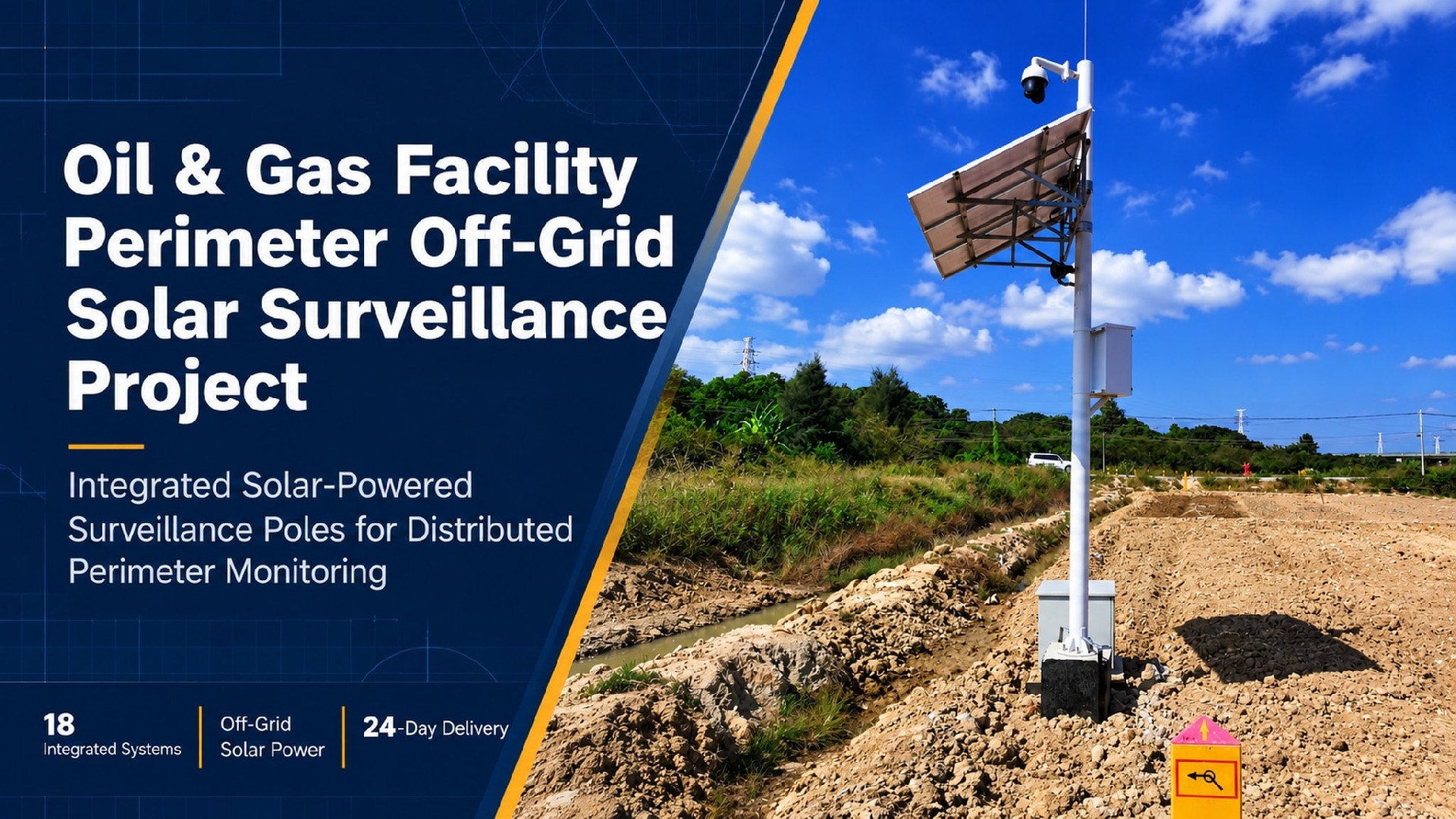
◎Deployment: 18 integrated off-grid solar surveillance poles
◎System Configuration: Pole + solar modules + LiFePO4 battery storage + MPPT controller + IP66 electrical enclosure
◎Delivery Period: 24 Days
This project was developed for perimeter video surveillance and intrusion detection at a small-to-medium oil & gas facility.
Surveillance points were distributed along the site boundary, with limited access to nearby grid power. A conventional grid-connected solution would have required additional trenching, cable installation, and associated civil works.
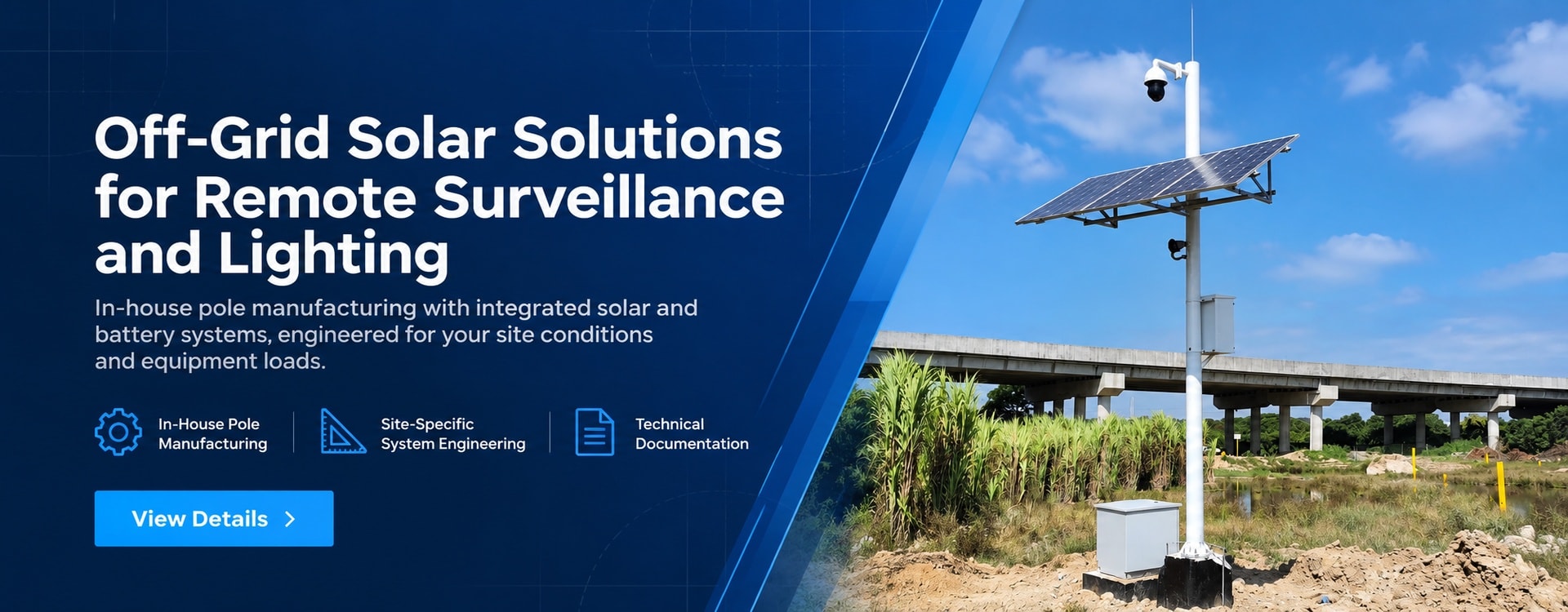
The project therefore adopted 18 integrated off-grid solar surveillance poles. Each pole functions as an independent power node, combining solar generation, battery storage, electrical control, and equipment support in one system.
Major components were integrated, wired, and pre-tested at the factory. On-site work was mainly limited to foundation fixing, pole erection, and final system commissioning, supporting phased installation and fast deployment under an EPC construction schedule.
This project was designed for standard non-hazardous perimeter locations. Zone 1, Zone 2, or other hazardous-area applications require separate system design based on the applicable area classification and equipment certification requirements.
Challenge 1 | Continuous Power at Remote, Off-Grid Surveillance Points
Perimeter surveillance points were located away from existing electrical distribution infrastructure. Extending grid power to each location would have required long cable runs and additional civil works.
For an off-grid system, the main design challenge is different: solar generation varies with weather and irradiance, while cameras, intrusion alarms, and communication devices require continuous power.
Engineering Response→
Daily energy demand was calculated from equipment power consumption and operating hours.
Solar array and battery capacity were sized according to local solar resources, peak sun hours, and the required autonomy period.
LiFePO4 batteries were selected for energy storage, with MPPT controllers managing charging and discharging.
Low-battery load priorities were defined so critical surveillance, alarm, and communication devices remain powered before non-essential loads.
Challenge 2 | Long-Term Outdoor Exposure to Dust, UV, and Temperature Swings
Equipment installed around the facility perimeter remains exposed to outdoor conditions throughout the year.
Dust accumulation can reduce effective solar irradiance on the PV modules, while prolonged sunlight and temperature cycling can accelerate the ageing of cables, seals, and exposed electrical components.
Engineering Response→
Poles were fabricated from Q355B structural steel and protected by hot-dip galvanizing.
IP66 electrical enclosures were used to reduce dust and water ingress.
Solar panel tilt angles were selected by considering solar exposure, wind loading, and dust accumulation.
Outdoor cables, seals, and exposed components were specified for UV exposure and temperature variation.
Challenge 3 | Distributed Sites and High Maintenance Effort
The 18 systems were installed at separate locations along the facility perimeter, increasing travel time and maintenance effort for routine inspection and fault diagnosis.
Inconsistent equipment configurations across different points would further complicate spare-parts management and servicing.
Engineering Response→
All 18 systems used a standardized solar, battery, controller, and enclosure configuration.
Main components were assembled, wired, and powered up for pre-delivery testing at the factory.
Where required by the project, interfaces were provided for battery status, charging/discharging data, and fault information.
Solar modules, batteries, and electrical enclosures were arranged with maintenance access in mind, simplifying inspection and component replacement.
Challenge 4 | Batch Delivery Aligned with the EPC Construction Schedule
This was a batch deployment rather than a single demonstration unit.
Consistency in pole structure, electrical configuration, and equipment interfaces was important to reduce site installation, commissioning, and acceptance work across all 18 locations.
Engineering Response→
The 18 systems were produced using standardized drawings, materials, and main electrical configurations.
Solar brackets, electrical enclosures, battery systems, and controllers were manufactured and integrated to the same project standard.
Each system was inspected and power-tested before shipment.
Packaging and delivery were organized to follow the site installation sequence, with the full batch completed and delivered within 24 days.
Eighteen integrated off-grid solar surveillance poles were delivered for distributed perimeter deployment across the oil & gas facility.
The project achieved:
→Reduced dependence on long-distance grid cabling at remote surveillance points.
→Consistent system configuration across all 18 locations, simplifying installation and future maintenance.
→Factory integration and pre-testing, reducing on-site wiring and commissioning work.
→Batch production and system integration completed within 24 days to support the EPC construction schedule.
This project demonstrates our capability to engineer and deliver integrated off-grid solar power systems for distributed perimeter surveillance applications.
Key capabilities include:
Solar and battery sizing based on load demand, local solar resources, and required autonomy.
Integration of pole structures, solar modules, LiFePO4 storage, MPPT control, and IP66 electrical enclosures.
Low-battery load prioritization to protect critical surveillance functions.
Standardized configuration and factory pre-integration for efficient batch deployment.
The solution is suitable for oil & gas facility perimeters and similar industrial surveillance locations where grid power is unavailable or difficult to access.