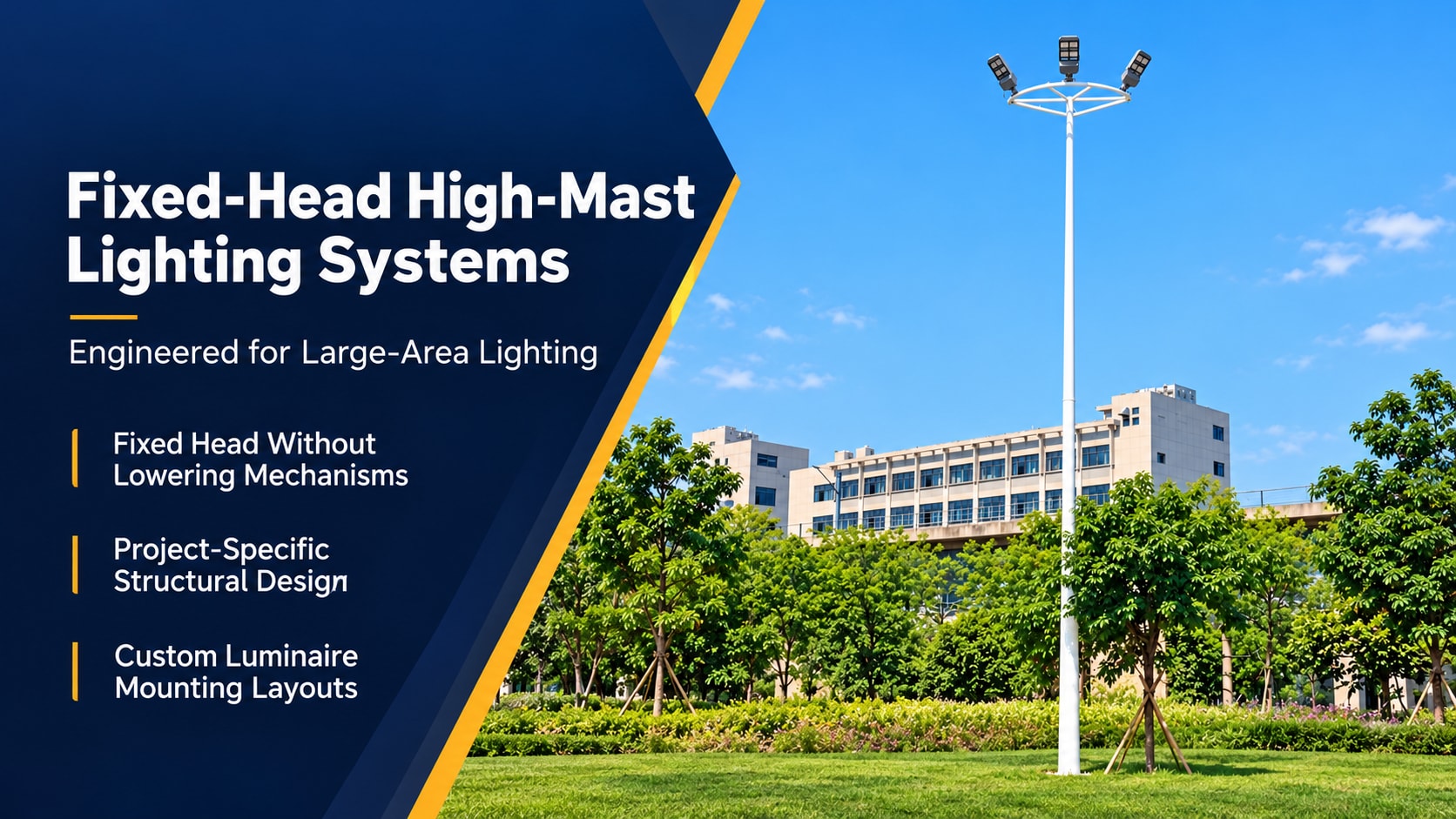
Product Overview
Two proven options exist for large outdoor lighting projects. Lowering high mast systems allow ground-level maintenance but carry higher upfront capital expenditure and ongoing operational costs. Conventional street poles cannot meet wide-area illumination requirements because of height restrictions.
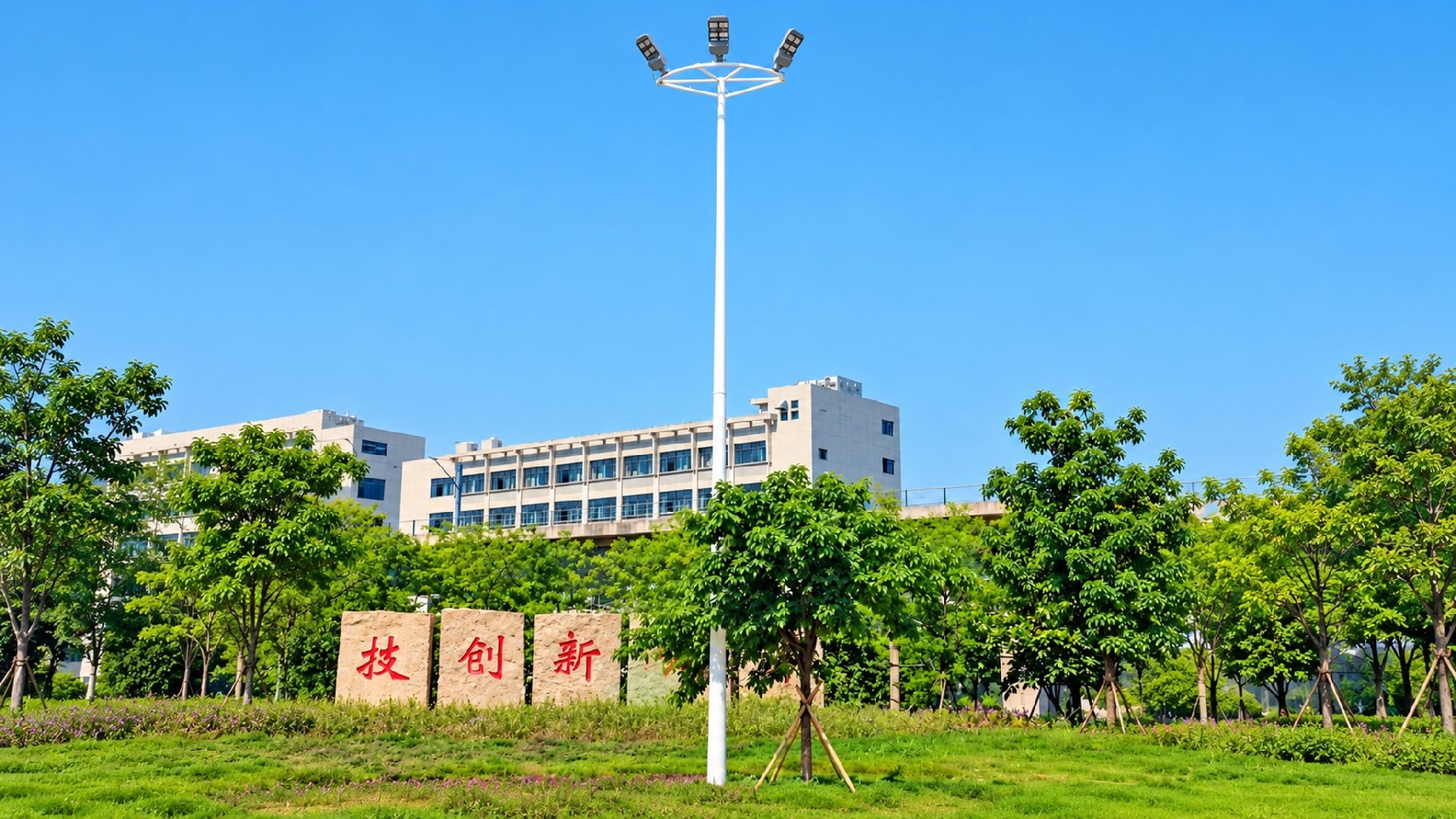
Fixed high mast lights feature a streamlined structure designed to minimize total project expenditure throughout the product lifecycle. Available heights: 15 m to 45 m. Suitable for airports, ports, stadiums, highway interchanges, industrial parks, and other extensive open-air facilities.
Fixed mast structures contain no moving components. The absence of hoist assemblies, steel cables, and drive motors eliminates risks associated with mechanical wear and fatigue failure.
Under typical operating conditions, upfront capital costs are 30%–40% lower than equivalent lowering high-mast systems. Total operational expenditure decreases significantly over an 8-year project lifecycle.
Luminaire maintenance is performed using mobile elevated work platforms (MEWP). On-site servicing costs are substantially lower than the specialized mechanical maintenance required for lowering systems.
Pole shafts and lamp frames undergo full hot-dip galvanization with a minimum zinc coating thickness of 85 μm. This metallurgically bonded zinc‑iron alloy provides dual protection: physical barrier and cathodic protection.
Optional polyurethane or fluorocarbon topcoats further extend corrosion resistance in aggressive environments. Salt spray testing exceeds 1,000 hours without red rust.
Without wearable moving parts such as cables and pulleys, all exposed metal surfaces receive complete anti-corrosion treatment with no unprotected weak points.
Pole sections utilize slip-joint or flanged connections. Individual segment lengths are limited to 12 m to fit standard 40-foot high cube containers.
Example: A 25 m pole assembled from three sections increases container loading efficiency by over 50%. Per-unit ocean freight costs decrease by 30%–40% compared to one-piece pole shipments.
All section joint welds undergo ultrasonic testing to ensure joint strength matches the base material, preserving structural integrity while optimizing logistics economics.
Octagonal, dodecagonal, and octadecagonal tapered pole profiles are optimized using wind tunnel data, achieving a drag coefficient 12%–18% lower than circular poles.
Wall thicknesses taper progressively from base to top to balance structural strength and self-weight. The structure withstands wind speeds up to 60 m/s.
Custom structural calculation reports are supplied for every project, incorporating site-specific wind, snow, and seismic load parameters.
Lamp frames accommodate 4–24 luminaires, with optical lenses tailored to specific site requirements.
| Application Scenario | Optical Strategy | Key Performance Index |
| Port & Yard | Narrow beam (10°–30°) | High vertical illuminance for container handling |
| Stadium | Wide beam + asymmetric distribution | Uniformity ≥0.7, compliant with broadcast standards |
| Highway Interchange | Batwing light distribution | 60–100 m coverage radius, zero dark zones |
| Airport | Directional lighting | Compliant with ICAO standards |
Industrial Park & Plaza | Wide-angle uniform lighting | Maximized site coverage |
Custom heights from 15 m to 45 m are available without tooling charges. Poles are pre-engineered with mounting interfaces for PTZ cameras, radar units, and 5G micro base stations. Integrating lighting and security infrastructure eliminates the need for separate poles and foundation works, reducing total project investment.
Mounting interfaces support major luminaire brands including Philips, GE, and Cree. Upon receipt of equipment specifications, interface drawings and load verification reports are delivered within 72 hours.
Custom brackets, arm lengths, tilt angles, and cable entry points can be manufactured according to your equipment CAD drawings. Pre‑drilled flange patterns are available upon request, compatible with mainstream floodlights, PTZ cameras (Axis, Bosch), radar, and environmental monitoring sensors. Pre‑fabricated cutouts minimize field modification and accelerate site installation.
Jump to : Commercial Terms | FAQ | Delivery Commitment
| Item | Parameter |
| Pole Height | 15 m – 45 m (customizable per project) |
| Material | Carbon steel(Q235B/Q355B) / Stainless Steel(304/316L)/ Aluminum Alloy(6063‑T6/ 6061‑T6)(Customizable) |
| Wall Thickness | 6-16 mm |
| Manufacturing tolerances | Flange flatness ≤0.5mm, shaft straightness ≤L/750, bolt hole deviation ±1.5mm |
| Pole Section Connection | Slip-joint, flange connection, or combined hybrid connection |
| Lamp Frame Capacity | 4-24 luminaires |
| Compatible Additional Equipment | LED floodlights, PTZ cameras, perimeter radar, environmental monitoring sensors |
| Surface Treatment | Carbon Steel: Hot-dip galvanizing (≥85μm) + outdoor electrostatic powder coating; Stainless Steel / Aluminum Alloy: Passivation / Brushing / Coating on request |
Supported by an ISO 9001:2015 quality management system, we can adapt pole design, manufacturing quality control, corrosion protection, and technical documentation to project-specific standards and local requirements, supporting overseas project approval, procurement, and acceptance.
Structural Design & Wind Load Verification: Structural calculations can be performed in accordance with EN 40 / EN 1993, AASHTO, applicable AS/NZS standards, SASO requirements, or other project-specified codes. Design verification can incorporate site wind speed, equipment loads, mounting height, and environmental conditions.
Welding & Manufacturing Control: Welding procedures and quality control can be adapted to applicable EN 1090 execution requirements and ISO 3834 welding quality requirements, with corresponding process, inspection, and documentation controls implemented as required by the project.
Corrosion Protection: Hot-dip galvanizing and coating systems can be configured according to the project environment and required service life. Treatments can be specified to ISO 1461, ASTM A123/A123M, or other project requirements for standard outdoor, coastal, high-humidity, and high-salinity environments.
Engineering Documentation Support: Project documentation can include structural calculation reports, shop drawings, material certificates, welding records, galvanizing or coating inspection reports, dimensional inspection records, and factory quality documentation for client, consultant, or EPC review.
Multi-Market Project Support: We support project requirements across Europe, North America, the Middle East, and Asia-Pacific. Applicable design standards, inspection requirements, and document packages can be defined according to the project location and technical specification.
Term | Detail |
| Customization | Supported — MOQ 1 unit |
| Lead time | Standard configuration: 3–4 weeks / Custom-engineered configuration: 4–5 weeks |
| Payment terms | 30% T/T advance · 70% before shipment · L/C at sight accepted |
| Trade terms | EXW: Specify named place FOB: Specify port of shipment CFR / CIF: Specify destination port |
| Inspection support | Third-party factory inspection by SGS / BV / TÜV welcomed |
| Samples | Available — sample cost credited against first production order |
⚡ Galvanic Corrosion Prevention: Carefully match fastener materials. When connecting dissimilar metals, use isolating non-conductive gaskets. (Service option: Pre-installed nylon/EPDM isolation gaskets available upon request).
💧 Drainage & Sealing: Keep base drainage openings unobstructed; hand-hole covers and seals must remain intact. Never bury flange plates underground.
🛡️ Surface Protection: Protect coated, passivated, and brushed surfaces from mechanical scratches during installation. Repair damaged areas with material-matched touch-up treatment: touch-up coating for carbon steel/aluminium coated finishes, local passivation for stainless steel.
🔌 Grounding Requirement: Complete proper grounding and equipotential bonding in compliance with local electrical codes.
🏗️ Foundation Rules: Anchor bolts and concrete foundations must satisfy local wind-load requirements. Erect poles only after concrete has fully cured.
⚙️ Lifting-Lowering Commissioning
①Pre-operation inspection: Check gearbox grease, intact wire rope, and smooth operation of safety pins.
②No-load test: Run one full lowering/raising cycle of the lantern ring before fitting luminaires; ensure smooth operation with no jamming.
③Lock verification: When the lantern ring is lowered, confirm the safety pin is locked, and the gear self-lock works — the lantern ring will not drop when releasing the handle.
④Post-raise inspection: After lifting the lantern ring to operating height, verify the automatic safety latch fully engages to hold the lantern ring securely.
We also provide custom wind-load calculation reports, 2D CAD drawings, installation manuals, and tender technical documents to support your global project approvals and customs clearance.
For general-purpose technical handbooks and safety guidelines, please visit our Download Center→
🚀 Rapid Delivery: Standard orders ship in 3–5 weeks. Custom schedules available.
🔒 Secure Financing: Staged payments via T/T or L/C ensure financial control.
👤 Dedicated Management: A dedicated project manager provides real-time production updates.
📦 Reliable Packaging: Moisture-proof and shock-resistant packaging ensures safe container and ocean transit.
📄 Technical Documentation: Full engineering files, including structural calculations, ship with every order.
I. Products & Selection
Q1: What is the core difference between fixed and raising high mast lighting systems?
A: Raising high mast systems utilize a winch and steel wire rope mechanism to lower the luminaire carriage to the ground for maintenance. They involve higher initial procurement costs and require periodic inspection and replacement of moving parts such as hoisting mechanisms, wire ropes, and brakes. Fixed high mast systems have zero moving parts, offering a lower total cost of ownership (TCO). Luminaire maintenance is performed via Mobile Elevating Work Platforms (MEWPs).
Q2: Which applications are best suited for fixed high mast lighting?
A: Fixed high mast systems are ideal for large open areas including airports, ports and container terminals, stadiums, highway interchanges, industrial parks, and large parking lots. They are particularly well-suited for projects where MEWP access is permitted during routine maintenance.
Q3: Can the mast accommodate security cameras, radar, or other auxiliary equipment in addition to luminaires?
A: Yes. The mast features pre-engineered mounting interfaces for PTZ cameras, radars, and 5G micro-base stations, enabling integrated lighting and surveillance deployments. Structural calculations are performed for combined lighting and security loads, and engineering calculation reports can be provided for tender submittal.
II. Delivery, Packaging & Commercial Terms
Q4: What is the standard production lead time?
A: Lead times vary based on order volume and custom engineering requirements. A formal production schedule is issued upon order confirmation.
Q5: Are complete accessory sets supplied?
A: Yes. Shipments are delivered as a complete package including the mast body, anchor bolts, junction boxes, and fasteners, accompanied by a complete set of documentation in English.
Q6: What payment terms are supported?
A: We support Letters of Credit (L/C) and escrow services. Alternative payment terms can be negotiated for large-scale framework agreements.
Q7: Are sample poles available for qualification?
A: Yes, sample poles are available for validation. Samples are manufactured using the same materials and processes as mass-production units. Sample and freight costs are borne by the buyer and can be credited against subsequent volume orders as agreed.
III. Maintenance & After-Sales Service
Q8: How are the luminaires maintained on fixed high mast systems?
A: Luminaire inspection and replacement are executed using MEWPs. Winch system maintenance, wire rope replacement, and lubrication servicing are eliminated.
Q9: What routine inspections are required?
A: An annual visual inspection is recommended to check for coating damage, fastener torque integrity, and surface corrosion. Any scratches on the galvanized layer or topcoat should be touched up promptly.
IV. Lighting Scope & Interface
Q10: Are LED luminaires included in the scope of supply?
A: We supply the high mast pole structure and luminaire bracket assembly; luminaires can be sourced independently by the purchaser. We provide mechanical interface drawings to ensure compatibility with major luminaire brands such as Philips, GE, and Cree.
Specifications are typical values for reference only under standard conditions — not a guarantee. Final performance shall be determined by project design calculations and factory test reports. Consult a local engineer before specifying.